
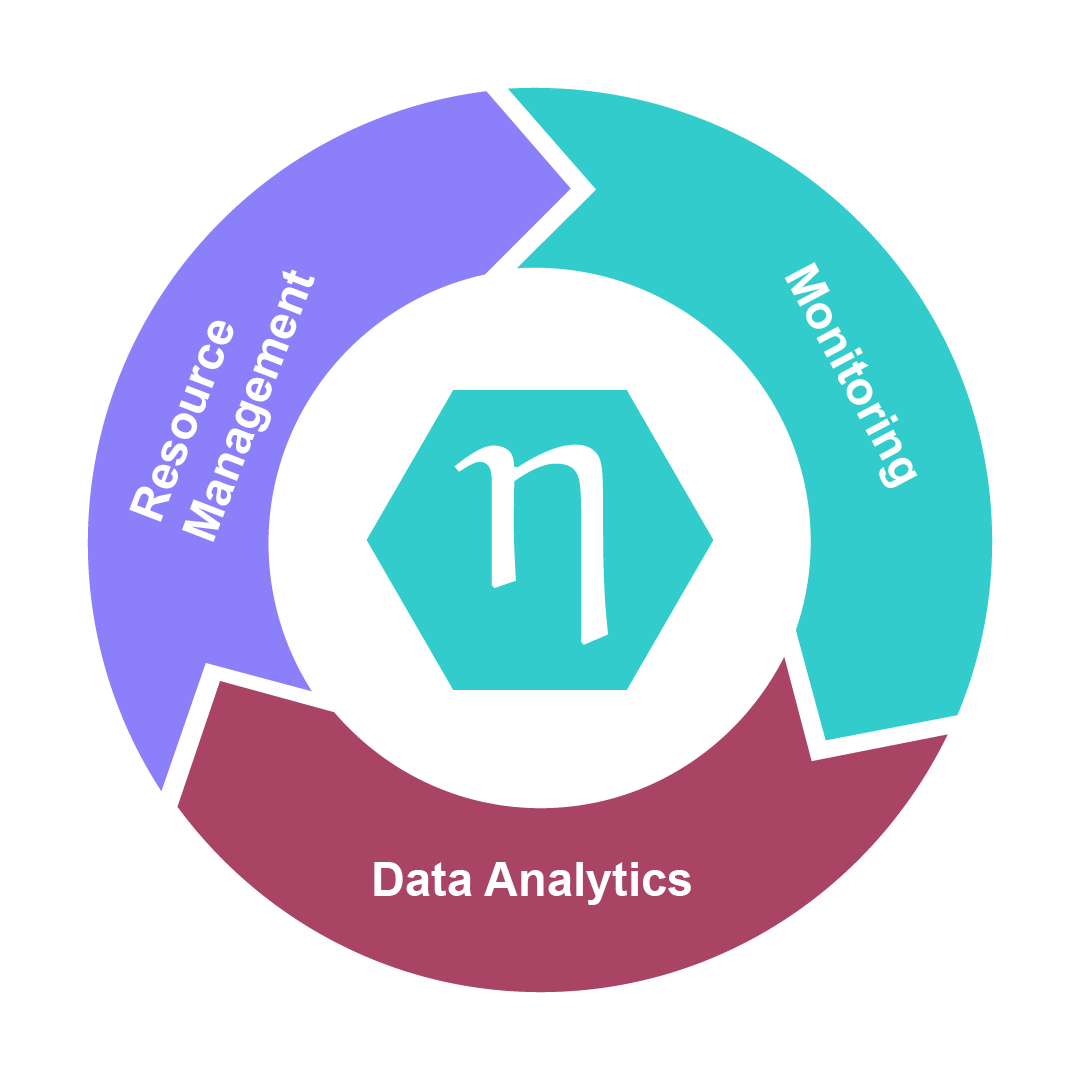
SEANERGYS integrates three tightly connected components which enable the coordinated optimisation of HPC and AI systems, supporting adaptive workload management and improved energy efficiency.

Components
SEANERGYS integrates three tightly connected components:
Comprehensive Monitoring Infrastructure (CMI)
A monitoring framework that collects and analyses detailed system-level data across hardware, software, and workloads, providing a holistic view of system behaviour and energy usage.
AI-Driven Analytics System (AIDAS)
An advanced artificial intelligence engine that interprets performance and energy metrics to predict system behaviour and identify optimisation opportunities.
Dynamic Scheduling and Resource Management (DSRM)
A scheduling and resource management system that leverages insights from AIDAS to optimise workload placement and system operation in real time.
Together, these components enable the coordinated optimisation of HPC and AI systems, supporting adaptive workload management and improved energy efficiency.
Architecture
SEANERGYS builds on the standard software stack architectures we find in today’s HPC systems, unifies software packages where currently multiple solutions are used across hosting sites and provides the needed interfaces to administrators and users/application developers to set policies, adjust behaviour and ultimately achieve efficient execution with optimal resource allocation.
The reliance on such existing software will lower the learning curve, accelerate achievement of production TRL levels and increase acceptance by HPC centres and their operators. It focuses on flexible integration, starting with Flux as a baseline scheduler and supporting future expansion or replacements where needed.
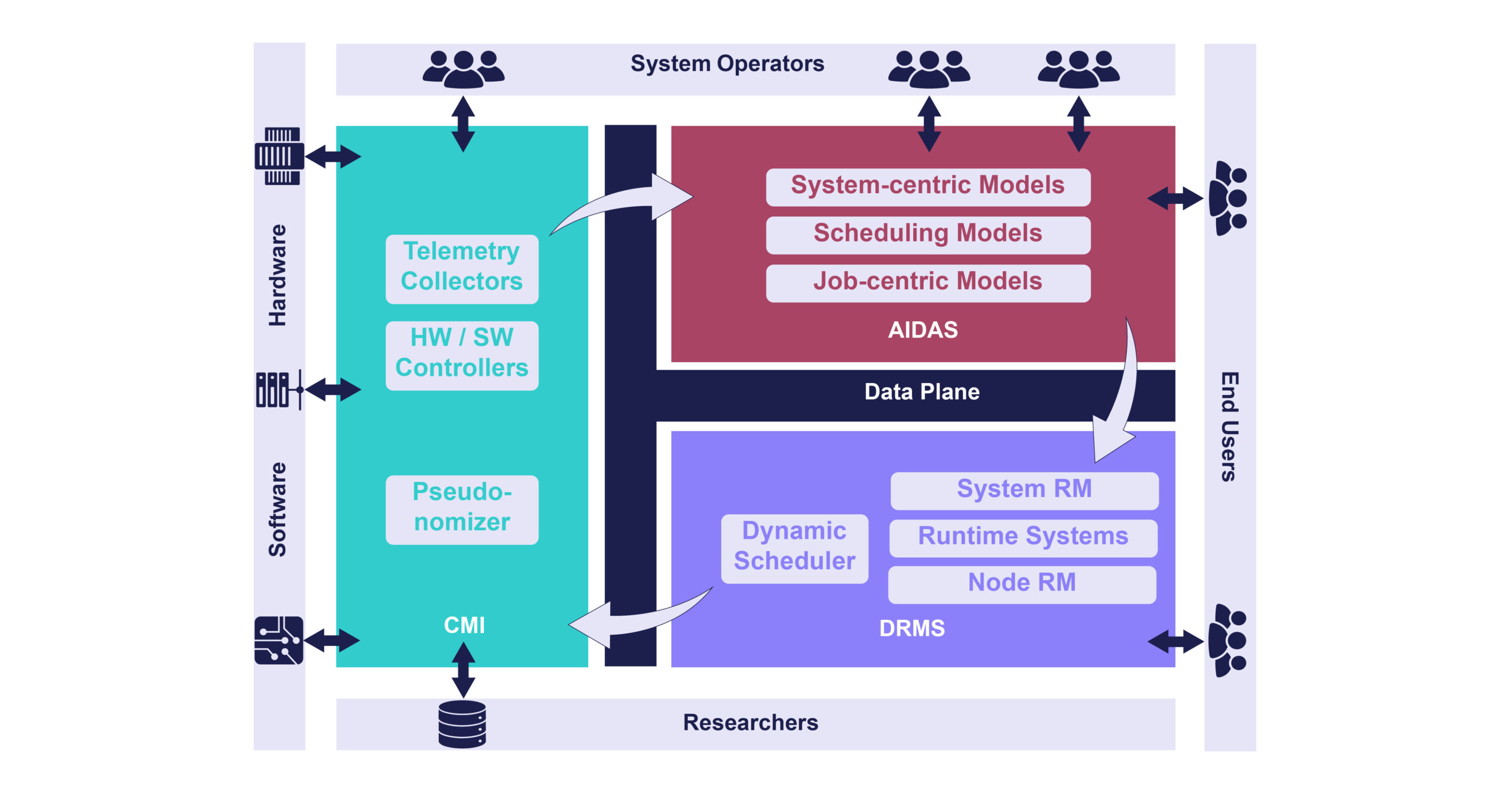
SEANERGYS Components
Unified Monitoring Infrastructure (CMI)
SEANERGYS includes a scalable monitoring system that aggregates:
- Node-level hardware and software telemetry
- Control plane insights (e.g., cooling systems, grid data)
- Application-level voluntary reporting (e.g., resource needs, progress)
All data flows through a standardized system-wide data plane, replacing fragmented monitoring setups and enabling powerful multi-layer analysis.
AI-Driven Analytics (AIDAS)
Data is processed by AIDAS, an advanced AI-based analytics system capable of both short-term feedback loops and long-term behavioural modelling.
Capabilities include:
- Real-time steering of system behaviour
- Offline training using historical data (“Model Zoo”)
- Visual analytics for admins and developers
Insight generation for tuning applications and system policies
Dynamic & Hierarchical Resource Management (DSRM)
Insights from AIDAS are fed into the DSRM (Dynamic Scheduling & Resource Management) system, which makes real-time decisions across multiple layers:
- System Manager: Enforces global power/energy constraints
- Node Manager: Adjusts frequencies, cache, bandwidth, etc.
- Co-Scheduler: Manages resource sharing across apps/workflows
- Job Manager: Tunes application-wide resource use within user space
Together, these components ensure adaptive, fair, and secure resource usage — completing SEANERGYS’ continuous optimization cycle.
Hardware and Software Sensors
Hardware and software sensors are the sources of information that help us understand how a supercomputer is running.
- Hardware sensors measure physical aspects of the system, such as CPU usage, temperature, power consumption, memory activity, and cooling performance.
- Software sensors track what jobs and applications are doing, including which resources they request and use, how they perform, and system events like warnings or errors.
By combining data from both types of sensors, SEANERGYS CMI can build a complete picture of the system, enabling smarter optimisation and more energy-efficient operation.
The Data Plane
The Data Plane makes monitoring data from the H/W and S/W sensors from the different parts of the supercomputing system, easy to access and use. It collects and provides it to AIDAS and also interfaces into DSRM. The Data Plane also connects into schedulers, and visualisation dashboards through a flexible interface.
By using a publish-and-subscribe approach, each component can receive exactly the data it needs, at the right level of detail and frequency. This simplifies integration, improves efficiency, and allows the system to adapt easily to new hardware, sensors, and workloads, enabling smarter and more energy-efficient operation