
SEANERGYS Use Cases

SEANERGYS brings together a comprehensive set of use cases collected across European High Performance Computing (HPC) centres and communities to guide the design of next-generation energy-efficient and intelligent HPC infrastructures.

These use cases serve as the primary requirements driver for the SEANERGYS software ecosystem and provide actionable and testable requirements for the three core framework pillars:

CMI — Comprehensive Monitoring Infrastructure
AIDAS — AI-Driven Analytics System
DSRM — Dynamic Scheduling and Resource Management

The overall objective is to maximise resource utilisation, reduce energy consumption, improve operational efficiency, and enable future European hosting sites and commercial adopters to deploy smarter HPC infrastructures.

How the SEANERGYS Use Cases Were Derived?

The SEANERGYS use cases were developed using a structured methodology designed to ensure broad applicability across European HPC environments.

The process combined:

  • Analysis of previous European and EuroHPC initiatives
  • Review of literature and existing operational practices
  • Experience from participating HPC centres
  • Interviews with system operators and domain experts
  • Identification of recurring operational challenges and shared terminology
  • Consolidation and normalisation of requirements across communities

This approach enabled SEANERGYS to move from broad exploration toward convergence, creating a unified and validated set of requirements that represent the real needs of European HPC sites and future adopters.

The use cases consolidate requirements from multiple stakeholder groups and provide direct guidance for downstream development activities across the project.

Stakeholders Benefiting from SEANERGYS

SEANERGYS addresses the needs of multiple groups across the HPC ecosystem, ensuring benefits for both system operators and end users.

Together, these stakeholders shape the requirements driving the SEANERGYS framework and represent the communities that will benefit from improved efficiency, observability, sustainability, and operational intelligence.

HPC Administrators

Responsible for operating and managing HPC infrastructures, policies, and system health.

Application Users

Researchers and users running scientific and industrial workloads on HPC systems.

Developers

Developers of applications, libraries, and tools seeking performance and optimisation insights.

Technical Engineers

Experts responsible for deploying, integrating, and maintaining HPC software and infrastructure.

List of Use Cases

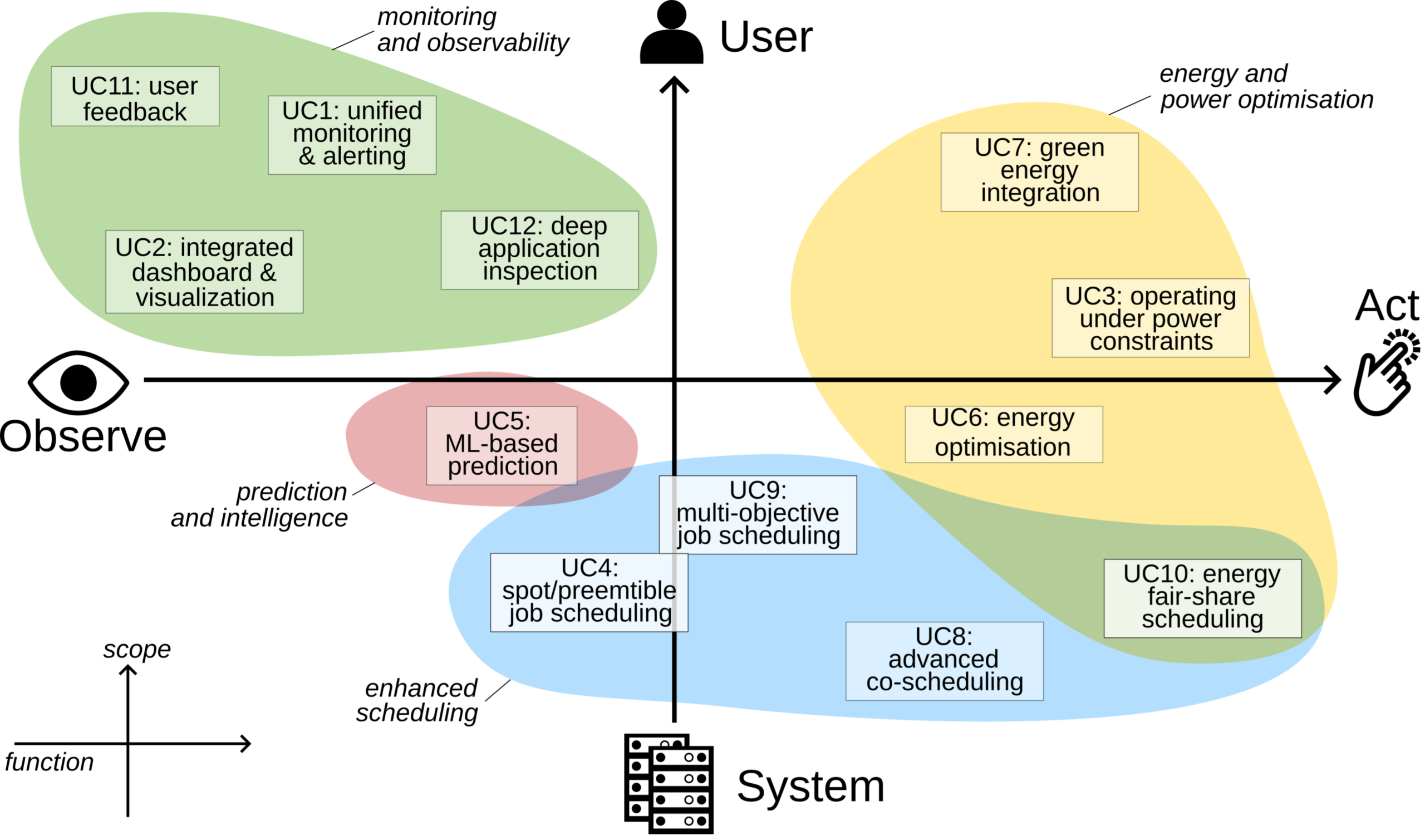
12 Use Cases provide actionable and testable requirements for the SEANERGYS solution.

UC1: Unified Monitoring and Alerting Platform

Provides AI-driven anomaly detection and intelligent alerting to proactively identify system issues and reduce operational downtime.

UC2: Integrated Dashboard and Visualisation Suite

Delivers unified dashboards and visual analytics that provide a consolidated view of system behaviour, resource usage, and operational insights.

UC3: Operating Under Power Constraints

Enables hierarchical power management across systems and infrastructure to operate efficiently within power and thermal limits.

UC4: Spot and Preemptible Job Scheduling

Introduces flexible scheduling policies that allow postponable workloads to improve utilisation and support energy-aware operation.

UC5: ML-Based Prediction Service

Provides predictive intelligence for runtime estimation, power forecasting, maintenance prediction, and system optimisation.

UC6: Energy Optimisation

Optimises workload execution to reduce energy consumption while maintaining acceptable performance levels.

UC7: Green Energy Integration

Aligns scheduling and operational decisions with renewable energy availability to reduce carbon footprint.

UC8: Advanced Co-Scheduling

Allows intelligent co-location of complementary workloads to improve resource utilisation and overall system throughput.

UC9: Multi-Objective Scheduling

Balances multiple operational goals simultaneously, including performance, energy efficiency, fairness, and sustainability.

UC10: Energy-Aware Fair Share

Extends traditional fair-share mechanisms by incorporating energy efficiency considerations into scheduling priorities.

UC11: User Feedback System

Provides users with automated insights and recommendations to improve application performance and resource efficiency.

UC12: Deep Application Inspection

Delivers detailed application-level analysis to understand workload behaviour and support future optimisation decisions.